Recovery & Performance
Does WHOOP Recovery Predict Your Lift Performance?
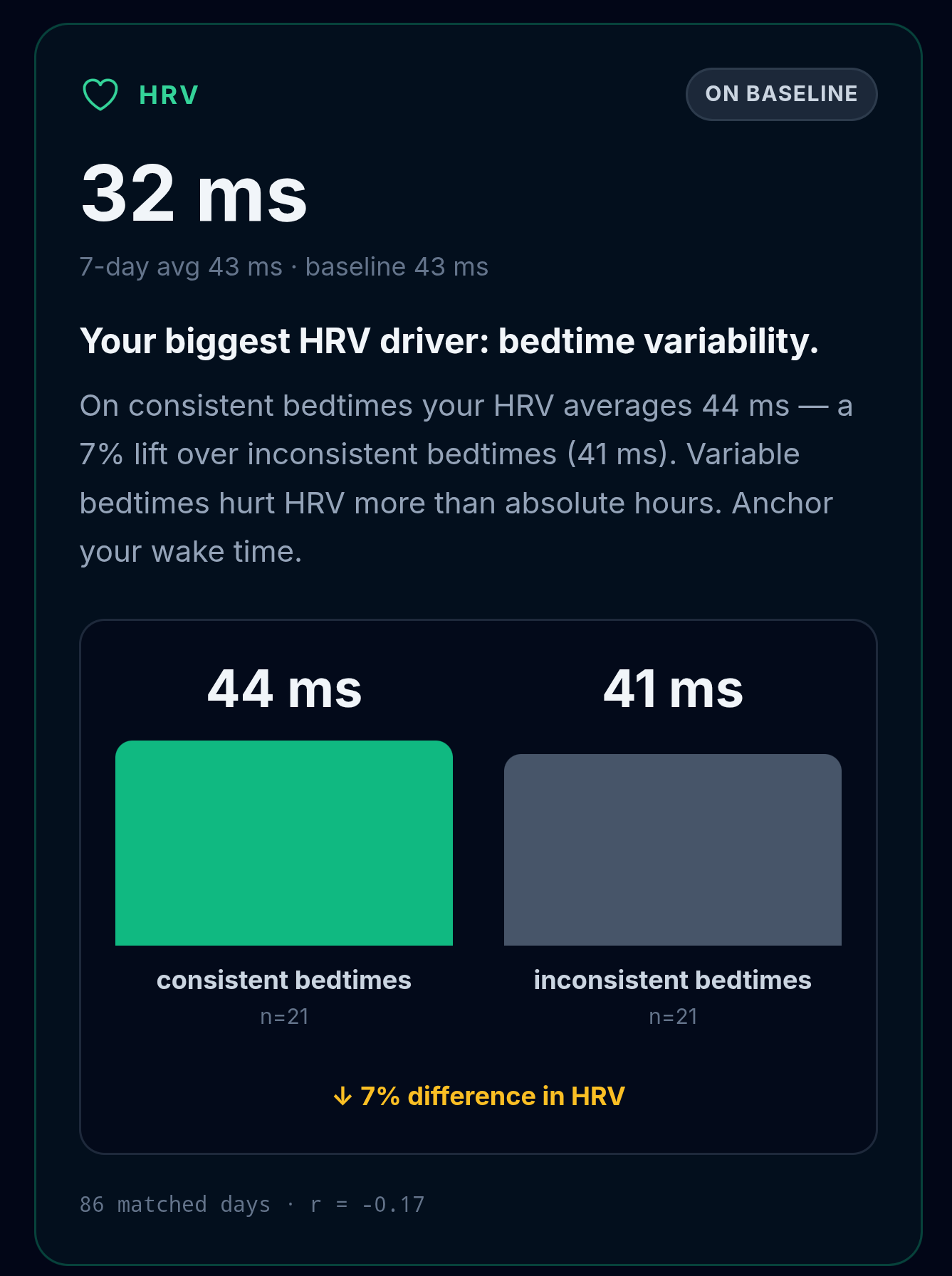
Every morning WHOOP hands you a number: 34% recovered, or 71%, or a green ring you take as permission to go heavy. The implicit promise is that the number means something for your training. But here's the question almost nobody actually answers: does your recovery score predict your lift output? Not in general, not for the population WHOOP studied — for you, on your bench, your squat, your deadlift. The data to answer that is sitting on your phone. It's just never on the same screen.
Short answer: does WHOOP recovery predict lift performance?
Sometimes — and the honest answer is you have to measure it. Recovery, HRV and sleep can correlate with lift output, but the strength of that link is individual. For some lifters it's real; for others it's noise.
To find out for yourself: put your WHOOP recovery data and your actual per-session lift output on one timeline, then look at the correlation across a real sample of sessions. StrengthInsight joins WHOOP recovery to your Strength Trainer lifts (pulled from screenshots) by date and reports the relationship with a sample size and a correlation value — not a hunch.
Close the gap between recovery and output
The two numbers WHOOP never puts on the same screen
- Your recovery score, HRV and sleep live on one screen, every morning
- Your Strength Trainer logs — sets, reps, load — live on another
- There is no view that ties them together across time
- So there's no correlation telling you whether recovery actually moved your numbers
How to fix it: get both layers on one timeline. Upload your WHOOP Strength Trainer screenshots, connect your recovery data, and let StrengthInsight measure the correlation for you.
Measure your correlation →Why this is a real question, not a settled one
It's tempting to assume the answer is obviously yes. You feel wrecked, your recovery is red, and your top set feels heavier — case closed. But "feels heavier" is exactly the kind of subjective impression that data exists to check. Recovery scores are built from HRV, resting heart rate and sleep, and those are genuinely informative about your autonomic state. What they are not is a guaranteed predictor of how much weight you'll move on a given day.
Plenty of lifters have hit PRs on a 38% recovery and bombed on an 85%. Strength output on a single session is noisy — it's affected by warm-up quality, caffeine, time of day, what you ate, how the previous set felt, and pure motivation. Recovery is one input among many. So the real question isn't "is recovery good for me?" It's narrower and far more useful: across many sessions, does my recovery score track with my lift output, and how strongly?
Why you can't answer it inside WHOOP
WHOOP is excellent at the recovery side. It shows you today's recovery, your HRV trend, your sleep performance — a clean physiological layer. And the Strength Trainer feature logs your sessions, capturing the strain and, where you enter them, your sets and reps. Both layers exist in the app.
What's missing is the join. WHOOP shows recovery on one screen and your strength sessions on another, and never lays them against each other on a single timeline. There's no chart with your recovery score on one axis and your best-set output on the other. There's no line that says "across your last 20 sessions, higher recovery lined up with higher output." The two data layers never meet, so the one thing you actually want to know — the relationship between them — is the one thing you can't see.
→ Put recovery and output on one timeline
This is the data gap. It isn't that the information is missing — it's that recovery and output are never tied together. You're left eyeballing two separate screens and forming an impression, which is precisely the situation that produces confident-but-wrong beliefs about your own training.
What it actually takes to answer it honestly
If you want a trustworthy answer rather than a story, the analysis needs a few things in place. None of them are exotic — they're just the basics of not fooling yourself with data.
- Both layers on one timeline. Each training day needs a recovery value (and ideally HRV and sleep) sitting next to a concrete output number for that session — best-set load, estimated 1RM, or session volume for a specific lift.
- A real sample size. Three sessions tell you nothing. With small n, any pattern you see is almost certainly noise. You generally want a few dozen paired data points before a correlation means much, and more is better.
- An actual correlation value. "It looks related" is not a finding. A correlation coefficient (an r value) puts a number on how tightly recovery and output move together, from roughly 0 (no relationship) to ±1 (a tight one). It also keeps you honest when the answer is "barely anything."
- The same lift, fairly compared. Comparing a heavy squat day to a light accessory day muddies everything. The cleanest test holds the movement roughly constant so you're measuring recovery's effect, not exercise selection.
And then you have to accept whatever it says. The finding might be a strong positive correlation, a weak one, or essentially none — and any of those is a legitimate, individual result. There's good evidence that recovery metrics relate to readiness on average, but averages aren't you. The whole point is measuring your correlation rather than assuming the population result applies to your barbell.
Product proof
How StrengthInsight measures the link
- Recovery, HRV and sleep pulled in and placed on the same timeline as your lifts
- Per-session output — best-set load and estimated 1RM — extracted from your WHOOP Strength Trainer screenshots
- A correlation value plus the sample size behind it, so you know whether the finding is signal or noise
- The strongest driver surfaced — whether your output tracks recovery, HRV, or sleep more closely
- An honest verdict when the relationship is weak or absent, instead of inventing one
It joins two layers WHOOP keeps apart, then reports the relationship as a number — not a feeling.
See your recovery-vs-output correlation →Where the lift data comes from (the API problem)
Here's a practical wrinkle worth being upfront about. WHOOP exposes recovery data through its API — recovery scores, HRV, sleep, strain. That part is accessible. But WHOOP does not expose Strength Trainer data through the API. Your sets, reps and weights aren't available programmatically, which means there's no clean way to pull both halves of the equation from one source.
So the lift side has to come from somewhere else. The approach StrengthInsight uses is screenshot OCR: you screenshot your WHOOP Strength Trainer session summary, the app reads the sets, reps and weights off the image, and then joins that output to your recovery data by date. Each training day becomes a paired row — recovery on one side, output on the other — which is exactly the structure a correlation needs. It's a workaround born of an API limitation, but it's what lets the two layers finally sit on the same timeline.
→ Join your lifts to your recovery by date
What a finding looks like — and how to read it honestly
Say you've logged 30 sessions of bench press alongside your recovery scores. A few outcomes are possible, and each one tells you something different:
| What the data shows | Rough r value | What it means for you |
|---|---|---|
| Strong positive link | ~0.5 to 0.8 | Higher recovery genuinely tends to mean heavier output. Worth scheduling hard sessions around recovery. |
| Weak / modest link | ~0.2 to 0.4 | Recovery nudges output but isn't the main driver. Useful context, not a rule. |
| No real link | ~0.0 to 0.2 | For this lift, your output doesn't track recovery. Don't let a red score talk you out of a session. |
Notice that "no link" is a real, valuable answer, not a failure. If your bench output simply doesn't follow your recovery score, that's worth knowing — it stops you from skipping productive sessions because of a number that, for you, doesn't predict anything. Equally, a strong link is actionable in the other direction: it justifies leaning into recovery-aware scheduling. The measurement is the point. Assuming the relationship and never checking is how people end up training around a number that was never theirs to begin with.
It's also why a single session is misleading. Fatigue, a bad warm-up or an off day can drag one session down regardless of recovery — which is a different problem from a genuine downtrend. Learning to tell a real dip from fatigue takes the same thing this analysis does: enough sessions on one timeline to see the pattern instead of the noise. And because sleep feeds directly into recovery, it's worth understanding what sleep does to your training data before you read too much into any single morning's score.
Two layers, one timeline
The reason this question stays unanswered for most WHOOP users isn't a lack of data — it's a lack of joining. Recovery is measured beautifully. Lifts are logged. They just never meet. The moment you put both on the same timeline with a decent sample and an honest correlation, the guessing stops and you get a real answer about your own training: strong, weak, or none.
That's the entire job StrengthInsight does here. It takes WHOOP's recovery layer, takes your Strength Trainer output via screenshot, joins them by date, and reports the relationship with the sample size attached so you can trust it. No causation overclaiming, no recycled population stats — just your numbers, measured against each other.
📊 Stop guessing whether recovery moves your numbers
Measure whether WHOOP recovery actually predicts your lifts
Connect your WHOOP recovery, upload a few Strength Trainer screenshots, and get the two layers on one timeline — with a real correlation and the sample size behind it. Free to start.
Try StrengthInsight →